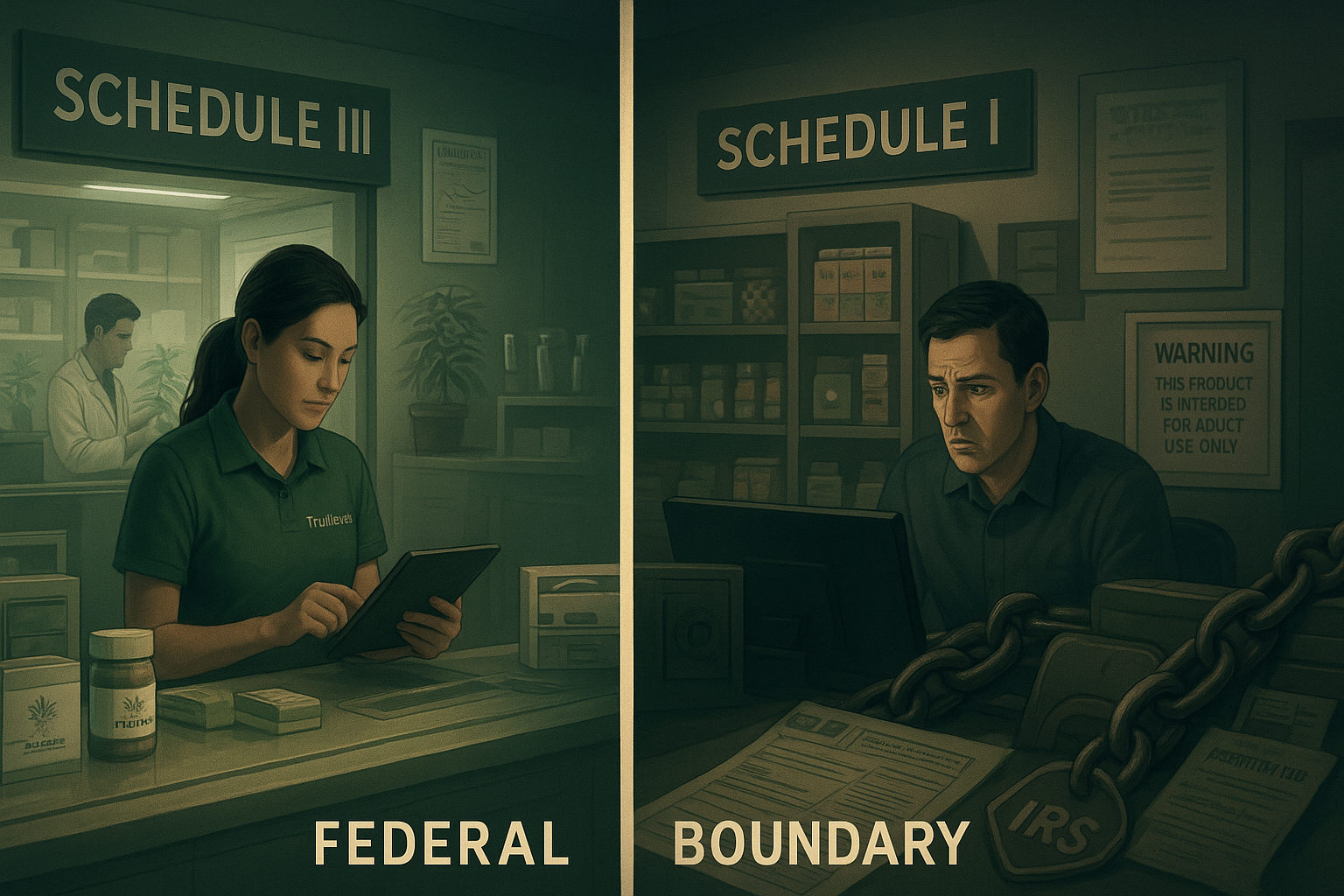
The Justice Department's decision to move medical cannabis from Schedule I to Schedule III under the Controlled Substances Act is the most significant shift in federal drug policy in decades - but for the operators running dispensaries, managing compliance logs, and trying to plan a business quarter, clarity remains elusive. Medical cannabis businesses stand to gain real tax relief and access to federal research channels. Recreational cannabis, used and sold legally in 24 states and the District of Columbia, stays Schedule I, a contradiction that now sits embedded in federal law with no obvious resolution date.
The 280E Question - and Why It Matters More Than the Headlines Suggest
For cannabis operators of any size, Section 280E of the Internal Revenue Code has been a persistent drag on profitability. Because 280E bars businesses trafficking in Schedule I or II controlled substances from deducting ordinary business expenses, cannabis companies have long paid effective tax rates that bear little resemblance to what a comparably sized retailer in any other sector would face. Moving medical cannabis to Schedule III breaks that constraint - at least on the medical side. Operators structured around medical licensing could, going forward, deduct rent, payroll, marketing costs, and cost of goods in the way a normal retail business would.
Trulieve Cannabis Corp., one of the country's largest multistate operators, has been direct about what that means operationally: the ability to reinvest more meaningfully in the states where the company holds licenses. That's not an abstract benefit. For a dispensary operator managing inventory across multiple SKUs, paying staff, and carrying the overhead of compliant packaging and seed-to-sale tracking systems, the difference between pre- and post-280E tax treatment can be material to the bottom line.
Here's the catch, though. Companies operating in both medical and adult-use markets - which describes most large cannabis retailers and many mid-size operators - are now running two products under two separate federal legal frameworks. Medical flower and recreational flower may sit in the same back-of-house storage room, move through the same point-of-sale system, and appear on the same wholesale menu. Separating them for federal compliance purposes is not straightforward. California's Department of Cannabis Control has already moved to address this, proposing emergency regulations that would allow businesses holding both license types to obtain separate licenses - a structural change designed to position operators to capture Schedule III benefits without tainting their recreational operations.
DEA Registration Requirements Add a New Compliance Layer
Rescheduling medical cannabis does not simply change a tax line item. Under the Controlled Substances Act, Schedule III classification carries its own federal registration requirements. Medical cannabis businesses could be required to register directly with the Drug Enforcement Administration, pay annual fees, and meet inventory, reporting, and security standards that were written for pharmaceutical manufacturers - not state-licensed dispensaries running METRC-based seed-to-sale tracking.
The overlap and potential conflict between DEA registration requirements and existing state regulatory systems is real, and regulators in multiple states - including Oklahoma, Vermont, and Washington - have said they're waiting on federal guidance before advising their licensees on what to do. Oklahoma offered a sharp illustration of how disjointed this process currently is: the state's Bureau of Narcotics sent a letter to licensed medical operators encouraging DEA registration and warning of possible license revocation for non-compliance, only for the Oklahoma Medical Marijuana Authority to clarify that it was itself unclear whether federal officials actually intend to enforce that requirement.
That is not a small administrative gap. Operators receiving conflicting signals from two agencies within the same state - one telling them to register, another saying nobody knows what registration actually means yet - cannot effectively plan their compliance posture. Spherex Labs, which operates in Colorado's combined medical and adult-use market, has chosen not to register at this time and is waiting for further federal guidance. That's a reasonable business decision given the uncertainty. It is also a decision that carries risk if federal enforcement expectations clarify in the other direction.
Research Access Opens, but Public Health Concerns Don't Go Away
One area where rescheduling delivers more immediate, less contested benefit is cannabis research. Schedule I classification has long made it difficult for academic institutions - particularly those receiving federal funding - to study cannabis products that consumers are actually purchasing. Rescheduling to Schedule III could allow state university research programs to work with commercially available products, including varying formulations and delivery methods, rather than being limited to federally authorized supply channels that often don't reflect what is on dispensary shelves.
The gap between what cannabis researchers can currently study and what operators are selling is significant. Questions about appropriate dosing, the comparative effectiveness of different delivery formats, and long-term health effects remain underexplored precisely because the research infrastructure has been constrained by scheduling. That begins to change - though the pace of any change in academic research timelines should not be overstated.
Public health voices have also pushed back on any reading of rescheduling as a safety endorsement. High-potency products - concentrates, vaping oils, processed edibles - are standard inventory in most adult-use dispensaries, and the clinical picture of cannabis use disorders, dependency patterns, and effects on mental health remains incomplete. Rescheduling reflects a policy and regulatory adjustment, not a clean bill of health. Dispensary operators with responsible retailing obligations should be mindful that the federal shift is being watched closely by public health advocates who argue it will reduce consumer risk perception without a corresponding increase in public understanding of potency.
What Operators Should Actually Watch Next
The DEA is scheduled to hold its first formal hearing on broader cannabis de-scheduling at the end of June. That hearing - covering recreational or adult-use cannabis - is the next structural variable, and the outcome is genuinely uncertain. A future administration could reverse the current rescheduling order; attorneys general in Indiana, Louisiana, and Nebraska have already filed a petition for review in the D.C. Circuit Court arguing the rescheduling process violated federal administrative law. Smart Approaches to Marijuana has filed a parallel legal challenge.
Meanwhile, federal banking access remains blocked for most cannabis operators. Banks have consistently declined to work with cannabis businesses because the broad federal illegality of marijuana - which persists for recreational cannabis - exposes financial institutions to regulatory risk regardless of state-level legality. Several congressional bills aimed at providing banking protections for cannabis businesses have been introduced over the years; none has passed. Until the recreational scheduling question resolves, or SAFE Banking legislation of some form advances, cannabis retailers will continue relying on cashless ATM systems, PIN debit workarounds, and cash-heavy operations that create real cost, security, and compliance exposure.
For operators right now, the most defensible position is structural preparation rather than premature action: reviewing license classifications for medical and adult-use separation opportunities, monitoring IRS and Treasury guidance on 280E applicability going forward, and keeping compliance counsel close as the DEA hearing and potential regulatory updates unfold. The federal government is moving - but it is moving slowly, unevenly, and with considerable ambiguity still baked in. "Everyone's kind of figuring it out right now," as one policy analyst put it. That is not a comfortable place to run a business, but it is, for the moment, the accurate one.