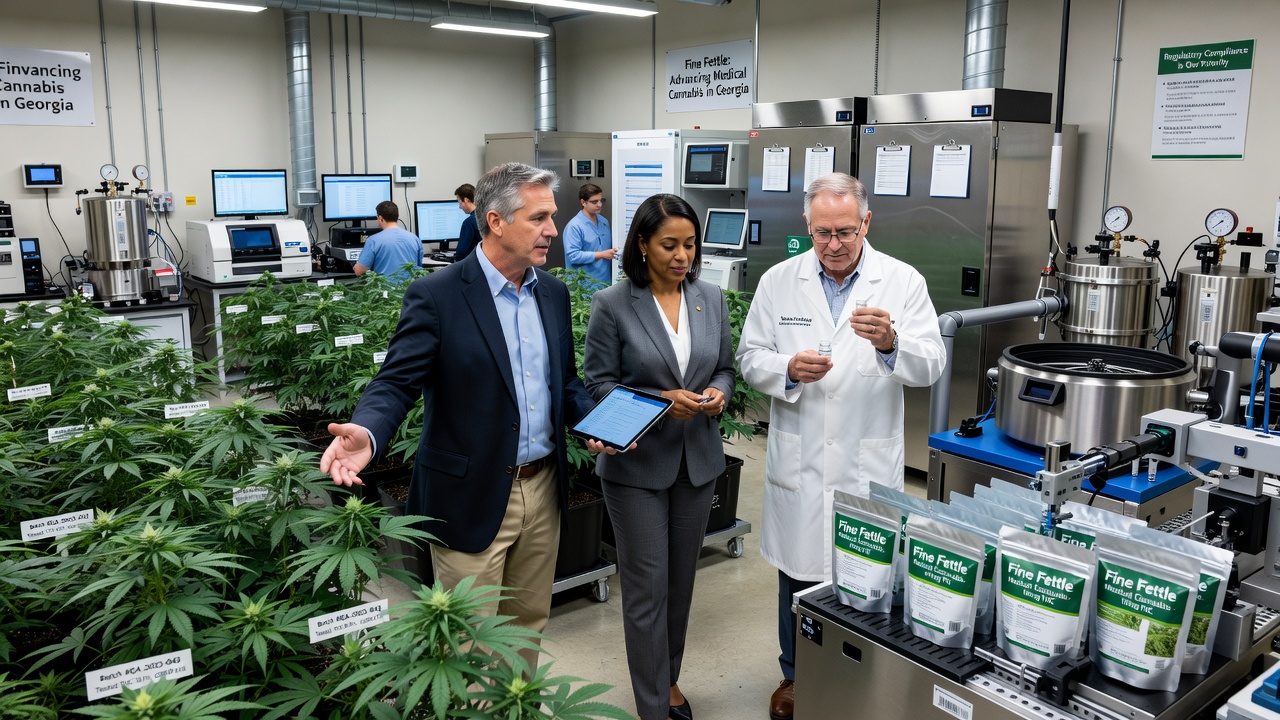
MACON-BIBB, Ga. - A decade after Georgia legalized low-THC medical cannabis, the program remains narrow, and the bills that could widen it keep dying in committee. Fine Fettle, one of only three licensed production companies operating in the state, recently walked lawmakers, physicians, and patients through its Macon cultivation and manufacturing site in an attempt to break that pattern. The tour was less about public relations and more about basic education: showing legislators what a regulated, seed-to-sale production system actually looks like on the ground.
That gap between perception and operational reality is worth sitting with for a moment. Georgia's medical cannabis market is tightly vertically integrated - a small number of licensed operators handle cultivation, manufacturing, and distribution to dispensaries under state oversight, with none of the sprawling multi-license structures seen in larger adult-use states. Compliance logs, batch tracking, and lab testing protocols govern every step, which is precisely the point Fine Fettle's market president, Judson Hill, wanted lawmakers to see firsthand. Retail infrastructure matters here too; dispensary operations in tightly regulated medical markets increasingly depend on systems built for compliance-first environments, the kind of dispensary pos maryland platforms use to track patient limits, product batches, and inventory across a state's approved product list. Georgia's program, still comparatively small, has not needed that scale of technology yet - but expansion would change that math quickly. dispensary pos maryland
Why the Legislation Keeps Stalling
Senate Bill 220 and House Bill 227, the most recent legislative attempts to broaden the program, both stalled before reaching a floor vote. The bills would have simplified patient access to medical cannabis cards and updated allowable product forms - a technical-sounding change that carries real clinical weight. Georgia's current program restricts product formulations more heavily than many other medical states, limiting the tools physicians can offer patients whose conditions don't respond well to the options currently on dispensary shelves.
State Representative Anissa Jones, who joined the Macon tour, described the visit as clarifying. Seeing a licensed facility firsthand, she said, underscored how controlled the process is compared to public assumptions about cannabis cultivation. That distinction - regulated production versus informal growing - is exactly the kind of framing operators need lawmakers to internalize if expansion bills are going to move past committee stage in future sessions.
The Access Gap Physicians Are Flagging
Dr. Elmore Alexander, who also participated in the tour, pointed to a specific clinical shortfall: existing product options adequately serve a majority of patients, he said, but a meaningful minority - patients with more complex or treatment-resistant conditions - need product forms the state doesn't currently authorize. That's not a small administrative detail. It's a supply chain and formulation constraint that limits what licensed producers are legally permitted to manufacture, regardless of clinical demand.
For operators, this creates a familiar tension. Manufacturing capacity and cultivation infrastructure exist to produce a wider range of formulations, but regulatory approval hasn't caught up. Expanding the product list would require legislative action, updated packaging and labeling standards, and likely new lab testing benchmarks - all before a single new SKU reaches a dispensary shelf.
What Expansion Would Mean for Operators
- Broader patient card access could increase dispensary foot traffic and steady demand for the state's limited number of licensed retailers.
- Updated product form rules would require manufacturers to adjust production lines, compliant packaging, and COA testing protocols.
- Continued delay keeps Georgia's medical market small relative to neighboring states, limiting wholesale volume and long-term investment incentive.
None of this guarantees quick movement. Georgia's legislature has shelved cannabis expansion bills before, and there's no indication the next session will play out differently absent sustained pressure from operators, physicians, and patients willing to keep making the case in person.