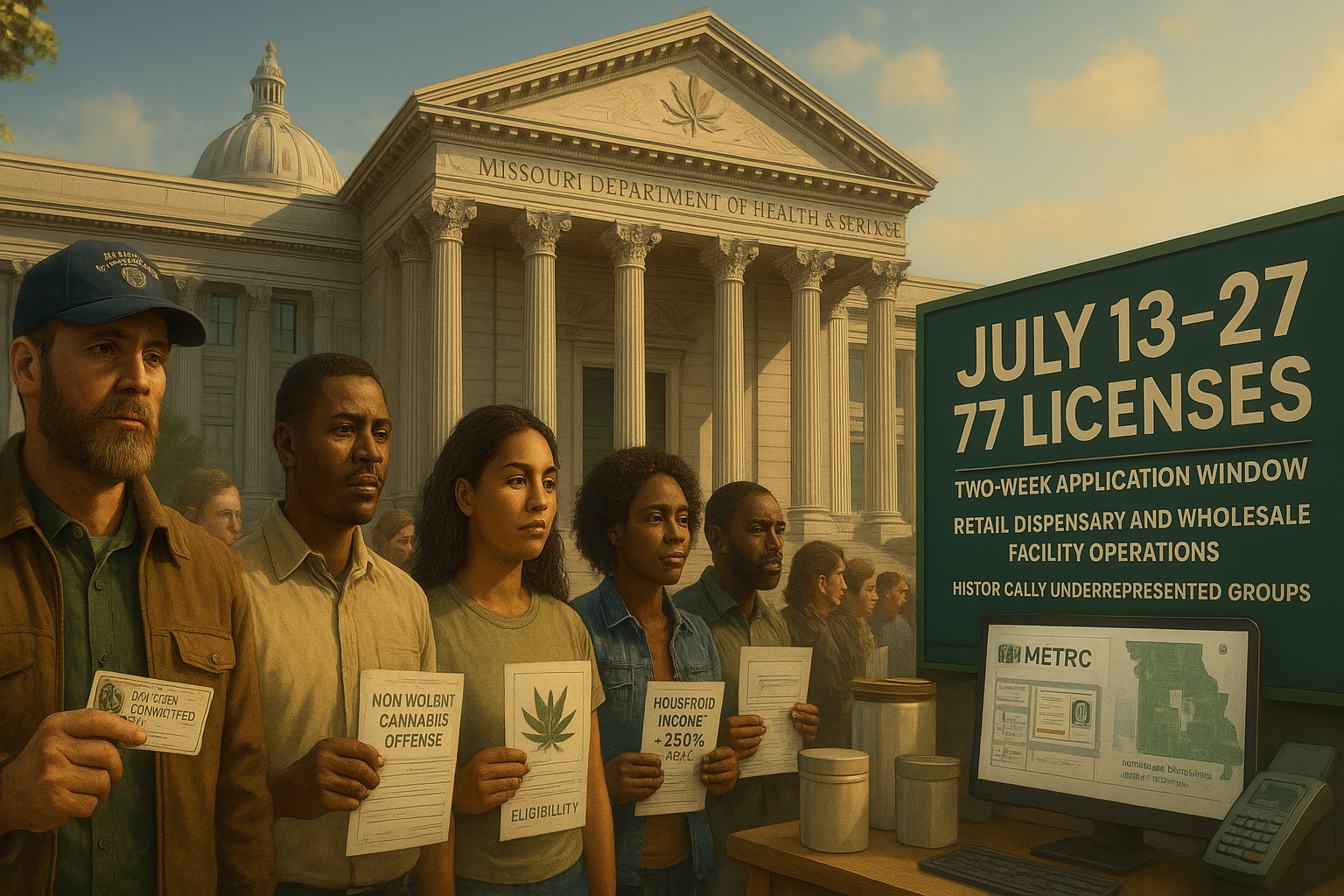
Missouri will open its third round of cannabis microbusiness license applications on July 13, with a two-week window running through July 27. The state Department of Health and Senior Services has confirmed 77 licenses are available - split between retail dispensary and wholesale facility operations - and all are reserved for individuals and entities historically underrepresented in the licensed cannabis market. A lottery is scheduled for September 9, with licenses expected to issue in December.
This is not a general licensing expansion. These microbusiness licenses carry hard eligibility gates designed to keep them out of the hands of existing operators. Applicants cannot currently hold any other cannabis license in Missouri - which means vertically integrated multi-state operators and established single-state licensees are locked out by design. That's the point. For cannabis technology vendors, compliance software providers, and point-of-sale companies looking to expand their small-operator client base in emerging state markets, it's worth watching how programs like this one perform at scale. Comparable frameworks in other states - including tools like cannabis POS for Arizona dispensaries built specifically for regulated retail environments - show that newly licensed microbusinesses often need turnkey operational infrastructure from day one, since many applicants enter the industry without prior dispensary management experience.
Who Actually Qualifies - and Why the Bar Is Specific
The eligibility criteria are notably granular, and deliberately so. Meeting any one of several defined conditions qualifies an applicant. Those conditions include:
- A net worth below $250,000 and income under 250% of the federal poverty level for at least three of the 10 calendar years before the application
- A valid service-connected disability card issued by the U.S. Department of Veterans Affairs
- A prior arrest, prosecution, or conviction - or that of a parent, guardian, or spouse - for a non-violent cannabis offense at least one year before the passage of Missouri's adult-use law (excluding convictions involving cannabis sales to minors or impaired driving)
- Residence in a ZIP code or census tract where 30% or more of the population lives below the federal poverty level, unemployment runs 50% above the state average, or the historic rate of cannabis-related incarceration is 50% higher than the statewide rate
- Graduation from an unaccredited school district, or residence in a ZIP code containing an unaccredited district for at least three of the past five years
Each of these criteria targets a distinct population - veterans, formerly incarcerated individuals, low-income residents, people from economically distressed communities. That's a broader eligibility architecture than many states use. Some social equity programs focus narrowly on criminal justice involvement; Missouri's framework also accounts for geographic economic disadvantage and educational access gaps. In practice, that could widen the qualified applicant pool considerably heading into the July window.
The Operational Reality for New Licensees
Getting a license is one thing. Opening and running a compliant cannabis retail operation is another matter entirely. New microbusiness licensees - particularly first-time operators - will face the standard compliance obligations of any Missouri cannabis retailer: seed-to-sale tracking, METRC integration, compliant packaging and labeling, age verification protocols, and state-mandated inventory controls. None of that gets waived because a licensee qualifies under a social equity framework.
That gap between license issuance and operational readiness is where microbusiness programs often struggle. Capital constraints are baked into the eligibility criteria - applicants by definition come from lower net-worth backgrounds - which makes pre-opening buildout costs, POS system procurement, compliance staffing, and working capital for initial wholesale purchasing genuinely difficult to absorb. Missouri doesn't appear to have attached a capital support component to this round, which means new licensees will be largely on their own to finance the path from approved application to open door.
What the Timeline Means for Prospective Applicants
The application window is short - two weeks, July 13 through July 27. That's not unusual for lottery-based licensing programs, but it does mean prospective applicants need to have their documentation in order before the window opens, not during it. Eligibility documentation - income records, poverty-level verification, VA disability cards, incarceration records, or school district accreditation history - takes time to gather and verify. Showing up on July 13 without that paperwork is a meaningful risk.
The September 9 lottery introduces an element that can frustrate even well-prepared applicants: a qualified, complete application doesn't guarantee a license. With 77 available slots and what could be a substantially larger pool of eligible applicants given the breadth of the qualifying criteria, competition for each license could be significant. Operators who don't receive a license in this round should note that Missouri has now run three application cycles - suggesting the state may continue expanding microbusiness access over time, though no future rounds have been formally announced.
For anyone advising prospective applicants - attorneys, consultants, community organizations - the window is close enough that outreach needs to start now.