Dispensary operators can hold every license, pass every lab test, and run seed-to-sale tracking without a single flagged batch - and still lose their bank account overnight. The reason has nothing to do with store performance. It's federal law, full stop, and no amount of internal compliance work fixes a problem that sits one level above the business.
A gap that compliance can't close
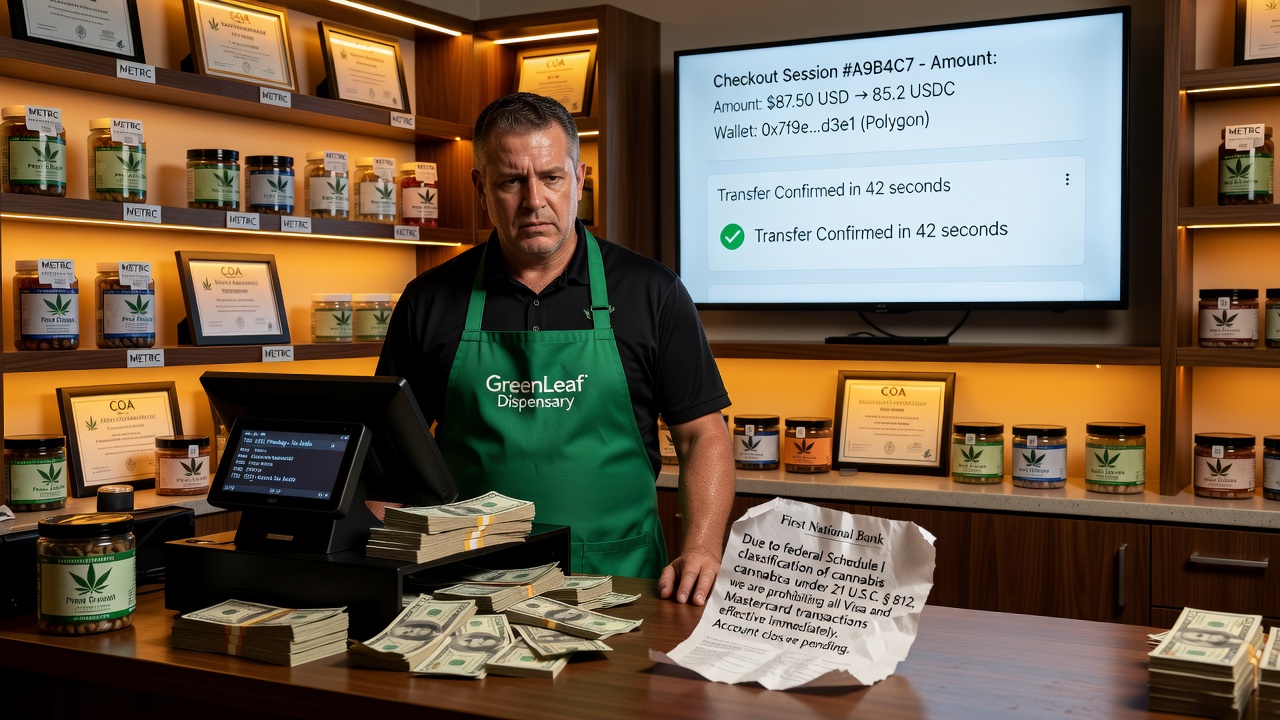
THC cannabis remains a Schedule I substance federally, regardless of what a state's adult-use or medical program permits. Visa and Mastercard built their rules around federal status, not state licensing, so they prohibit the category outright. Banks face a parallel calculus: processing dispensary deposits means potential federal money-laundering exposure, and most institutions decide the account isn't worth the risk. This is why a fully licensed, state-compliant operator with clean METRC records and audited inventory can still get a termination notice from its bank with little warning.
That's the part worth sitting with. This isn't a CBD situation, where hemp-derived products under the legal THC threshold face category-based scrutiny but generally retain some banking access. THC dispensaries sit in a harder bucket - outright refusal, not conditional approval. Two different risk profiles, often confused in trade conversation, and the confusion leads operators to apply the wrong fix.
Why cash-only isn't really a solution
Faced with no card processing, most dispensaries default to cash. It works, in the sense that sales still happen. But cash-only retail creates its own compliance burden: armored transport costs, inventory shrinkage risk, awkward 280E tax filings when deductions are already limited, and a security liability that insurers price accordingly. Budroom staff end up reconciling drawers by hand while a POS terminal sits half-useful, logging transactions it can't settle electronically. For delivery and online orders specifically, cash collection at the door adds driver risk and slows order throughput - not a small issue for operators trying to compete on convenience.
Non-custodial settlement as a workaround, not a loophole
One alternative gaining attention routes around the card networks entirely rather than trying to negotiate with them. A customer pays by card through a hosted checkout page; a licensed on-ramp converts that payment; the dispensary receives settlement in a stablecoin at a wallet it controls, typically within about a minute. Because no card-network relationship or dispensary bank account sits in the middle, there's nothing for Visa, Mastercard, or a nervous bank to shut down.
- No card-network merchant agreement to violate category restrictions against
- No deposit account exposed to a bank's periodic compliance sweep
- Settlement speed that makes same-day accounting far simpler than cash drawers
In practice, though, this is a payments mechanism, not a license. It doesn't change what a dispensary is legally allowed to sell, where, or to whom.
The legal responsibility doesn't move
Whether a dispensary can operate at all, under what license, and within which jurisdiction remains entirely the operator's responsibility to confirm with counsel - not something a payment tool can determine or guarantee. State cannabis law varies sharply county to county in some cases, and federal illegality hasn't gone anywhere. Age verification, compliant packaging, COA disclosure, and local zoning rules still apply regardless of how a transaction settles. A settlement workaround solves a banking gap; it does not substitute for licensing diligence, and operators who treat it that way are taking on risk they haven't priced correctly.