A federal law that redefines hemp is already on the books, and it will reshape which cannabinoid products can legally sit on a retail shelf. Signed in November 2025, the measure swaps the old delta-9-only threshold for a total-THC standard and caps finished products at 0.4mg of total THC per container. The catch: the effective date keeps moving, and operators building 2026 inventory plans are working against a target that shifted once already and could shift again.
For dispensary operators and hemp retailers trying to plan SKU management around this, the mechanics matter more than the headlines. The 2018 Farm Bill measured only delta-9 THC by dry weight, which is how THCA flower, converted delta-8, and similar products built a market - they simply didn't register on that scale. Section 781 of the FY2026 appropriations law closes that gap by counting THCA toward the total, adding a per-container cap for finished goods, and excluding lab-synthesized cannabinoids outright regardless of potency. Retailers operating across multiple jurisdictions, including those relying on dispensary software in Saskatchewan for cross-border inventory and compliance tracking, are watching this closely because a federal redefinition changes the compliant-product list everywhere at once, not just in states that opt in. dispensary software in Saskatchewan
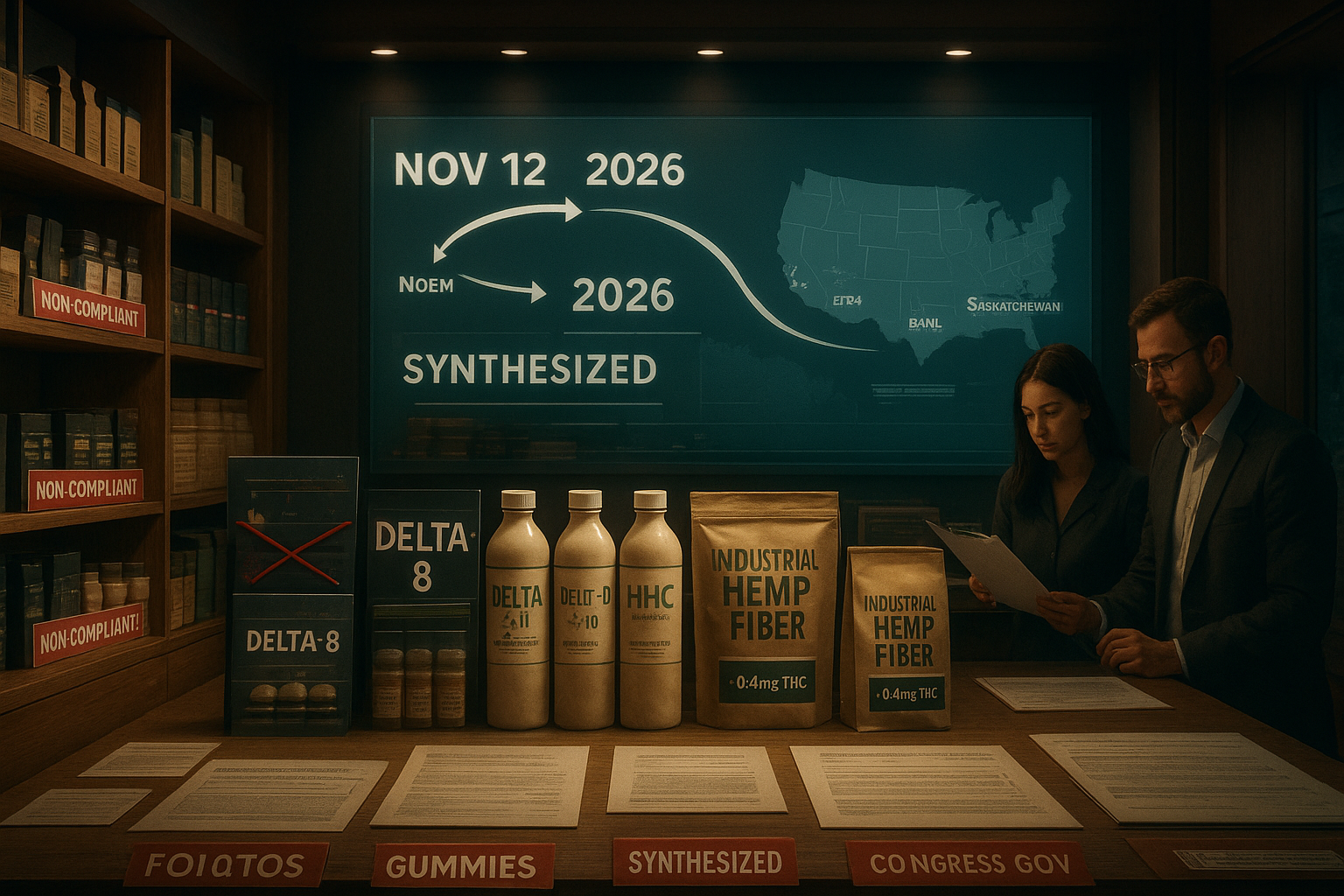
The timeline itself is the part still in motion. The law's original effective date was November 12, 2026. A Senate-passed stopgap funding bill would push most of that to December 11, 2026, but only for naturally derived cannabinoids like THCA - synthetics such as delta-8 and HHC stay on the earlier date regardless of what the House does. That bill still needs House passage and a presidential signature before December 11 becomes anything more than a placeholder. Operators should treat it exactly that way: a placeholder, not a locked compliance date.
What This Means for Product Assortment and Compliance Logs
For a store manager building a wholesale menu right now, three categories carry the most exposure. THCA flower, pre-rolls, vapes, and concentrates fail the total-THC math once raw THCA counts against the limit - typical flower testing well above 20% THCA has no path to compliance under this standard. Delta-9 gummies and beverages at current dosing routinely exceed 0.4mg per container, which means reformulation or removal, not a labeling fix. And delta-8, delta-10, and HHC products lose their footing entirely because they're synthesized from hemp-derived CBD rather than occurring naturally - that exclusion applies no matter how low the potency runs, and it isn't covered by any proposed delay.
What survives, for now, is narrower than most retail buyers expect: industrial hemp grown for fiber, grain, or seed, plus CBD products that stay under the container cap. The FDA was directed to publish clarifying cannabinoid lists that haven't materialized yet, which leaves compliance teams working from the statute itself rather than agency guidance. That's an uncomfortable position for anyone updating COA requirements or lab-testing protocols on a fixed timeline.
State Rules Still Set the Floor Beneath Federal Timing
Here's the part operators sometimes miss: a permissive state law doesn't buy an exemption from the federal calendar. States have already moved in different directions - California's AB 8 restricts THCA to licensed dispensaries, Oregon and Connecticut apply total-THC testing standards, New Jersey has banned intoxicating hemp retail outright, and litigation has paused enforcement in Texas. When the federal definition changes, it changes as a national floor. State rules can add restriction on top of that floor; they can't substitute for it. Multi-state operators building compliant packaging and testing programs need to track both layers, because a product cleared under state law today may still fall outside the federal definition once the effective date lands.
The Practical Takeaway for Operators
Nothing here is settled, and that's the honest summary. Repeal, further delay, and regulate-instead-of-ban proposals are all circulating, and none has advanced with real leadership backing. For now, the enacted law is the only fixed point - everything else, including the December 11 date, is a bill in motion. Operators should treat current planning cycles as provisional, keep compliance logs current against both federal and state standards, and check primary sources like Congress.gov rather than secondhand coverage before making inventory or reformulation decisions tied to a date that has already moved once this year.