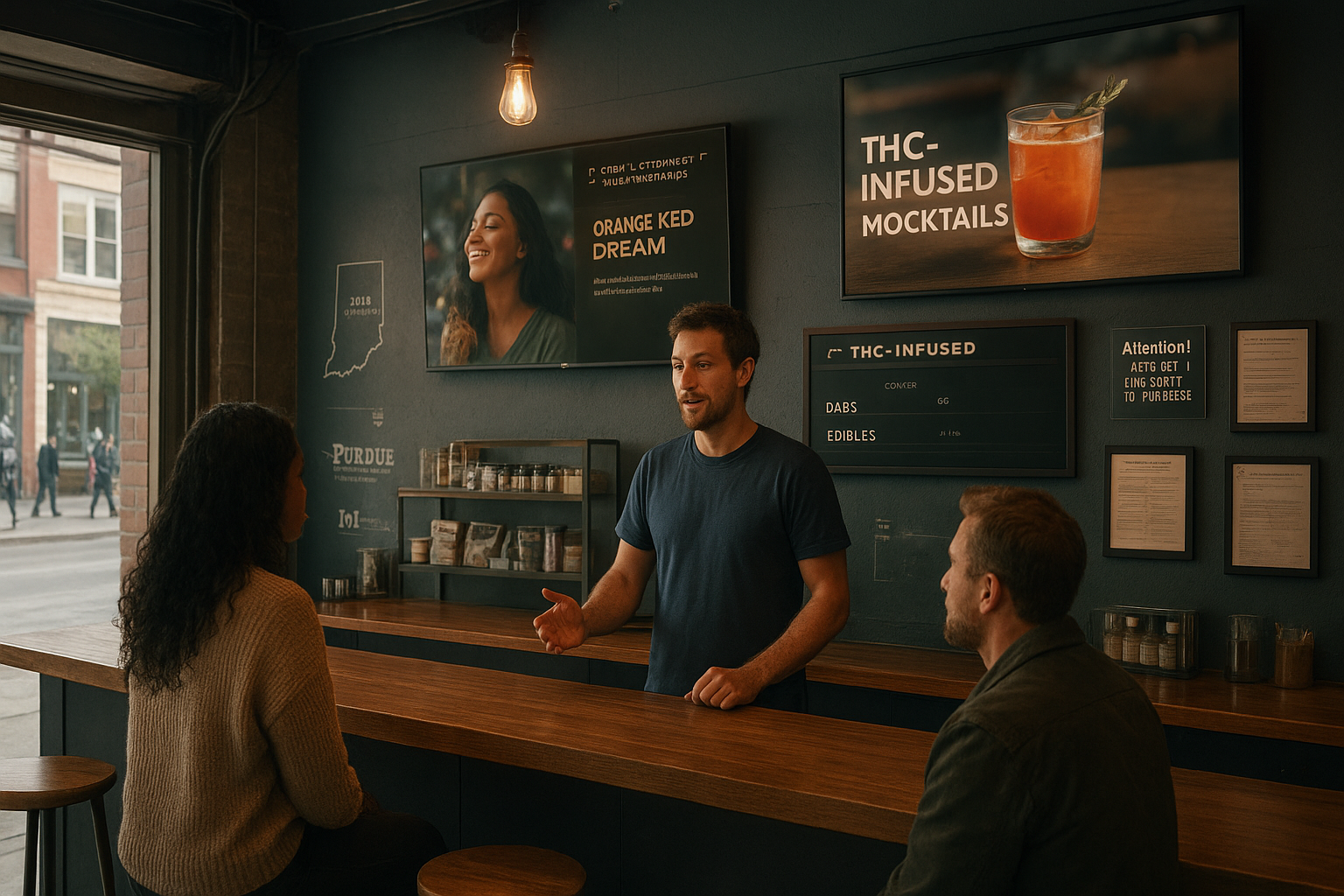
WildEye Cannabis in Indianapolis's Fountain Square neighborhood looks, at first glance, like a bar - garage door open to the street, stools at the counter, TVs running commercials. What it sells, however, is not alcohol. THC-infused mocktails, dabs, and edibles make up the menu at this cannabis consumption lounge, operating legally under a federal framework that Indiana legislators came close to dismantling earlier this year. For hundreds of small businesses across the state, the continued existence of that framework is not an abstraction - it is the difference between open doors and forced closure.
The operative mechanism is the 2018 federal Farm Bill, which drew a bright regulatory line between hemp and marijuana based on delta-9 THC concentration: below 0.3% by dry weight is hemp; above is controlled marijuana. Indiana prohibits marijuana in all forms, but hemp is legal - and that distinction has enabled an entire retail category to take root in a state where none would otherwise exist. The compliance calculus is delicate. Operators in states with mature adult-use programs rely on seed-to-sale tracking, state-issued licenses, and point-of-sale systems built to flag age verification and product limits. In Indiana, there is no equivalent regulatory architecture. Businesses selling hemp-derived THC products operate without the licensing scaffolding that, say, POS software for Alaska cannabis retailers is specifically built to support - no METRC integration, no excise tax reporting tied to a cannabis-specific license, no COA submission requirements enforced at the retail level. That gap is precisely what critics of the current Indiana system point to as a public safety concern.
Indiana Senate Bill 250, which died in early 2025 before reaching a House floor vote, would have placed hemp-derived consumables under the oversight of the state's Alcohol and Tobacco Commission, established age restrictions, aligned per-container THC limits with federal thresholds, and created a licensing pathway. It passed the Senate 35-13 but ran out of time in the House. Supporters of tighter rules, including the Indiana Drug Enforcement Association, argued the bill was about placing meaningful guardrails on psychoactive products - not shutting down small businesses. Opponents said the bill's scope was broad enough to affect not just THC beverages and edibles, but hemp-derived lotions, soaps, and CBD products as well.
What the Regulatory Vacuum Actually Costs Operators
Here's the catch with operating in a gray-zone market: the absence of regulation feels like freedom until it becomes a liability. Without a licensing structure, hemp retailers in Indiana have no formal compliance framework to point to - no state-issued license on the wall, no inspection record, no mandatory lab-testing requirements enforced at point of sale. That makes them structurally vulnerable every time a legislative session opens. A bill does not need to pass to cause damage; the uncertainty alone affects supplier relationships, lease negotiations, and investment decisions.
WildEye owner Nicholas Brown said he wants proper regulation - specifically age restrictions and product safety oversight. That position is more common among established hemp operators than the debate sometimes suggests. Responsible retailers understand that a documented compliance record is the best long-term protection against sudden regulatory shifts. Without one, every session in a Republican supermajority statehouse is a threat to the business model.
The consumption lounge format Brown operates adds another layer of complexity. Unlike a dispensary selling packaged product for off-premises use, a lounge involves on-site consumption, which raises questions about liability, dosage monitoring, staff training, and local zoning - none of which Indiana currently addresses through cannabis-specific statute. In states with licensed adult-use consumption lounges, operators face detailed rules covering ventilation, serving limits, age verification protocols, and staff certification. Indiana's silence on those points is not a regulatory advantage; it is an unresolved risk that sits on the operator's balance sheet.
The Agricultural Dimension Most Retailers Overlook
The consumer retail story gets most of the attention, but hemp's economic footprint in Indiana extends well into the agricultural supply chain. Purdue University's hemp extension program has documented that Indiana's climate and soil conditions support hemp cultivation - the state has historical roots in the crop going back decades before federal prohibition. The current processing infrastructure, however, skews heavily toward CBD extraction. Grain and fiber processing capacity is limited, which constrains farmers' ability to diversify into industrial hemp applications and keeps shipping costs high by pushing raw material out of state for processing.
For cannabis-adjacent businesses - packaging suppliers, extraction labs, ingredient manufacturers, logistics operators - Indiana's underdeveloped processing infrastructure represents both a gap and an opening. If the regulatory environment stabilizes, investment in in-state processing could lower input costs across the supply chain and reduce the price volatility that currently makes it difficult for small hemp retailers to manage inventory and wholesale pricing with any consistency.
What Comes Next, and What Operators Should Watch
Three of Indiana's four neighboring states have legalized cannabis for adult use; Kentucky has moved on medical. That border-state reality matters commercially - Indiana consumers have legal alternatives within driving distance, which puts pressure on in-state hemp retailers to compete on experience, product quality, and price. WildEye's lounge model is a direct response to that competitive reality: if you can't sell regulated marijuana, you build an environment compelling enough that customers stay local.
SB 250 failed, but it was 82 pages long and cleared the Senate. A version of it - or something similar - will come back. When it does, the businesses most likely to survive it are those that have already built voluntary compliance practices: documented age verification, third-party lab testing with current certificates of analysis on file, clear product labeling, and staff training records. That is not a guarantee of favorable treatment in any future legislative process. But it is the difference between an operator who can credibly argue for reasonable regulation and one who cannot.
Justin Swanson, a lobbyist and attorney who chairs the cannabis practice group at Bose McKinney & Evans, put it plainly: if the Farm Bill loophole has been open for twelve years, calling it a loophole at this point undersells how established the industry has become. The question for Indiana policymakers, and for the businesses operating in the state, is whether the next legislative attempt produces workable rules - or simply closes the market.