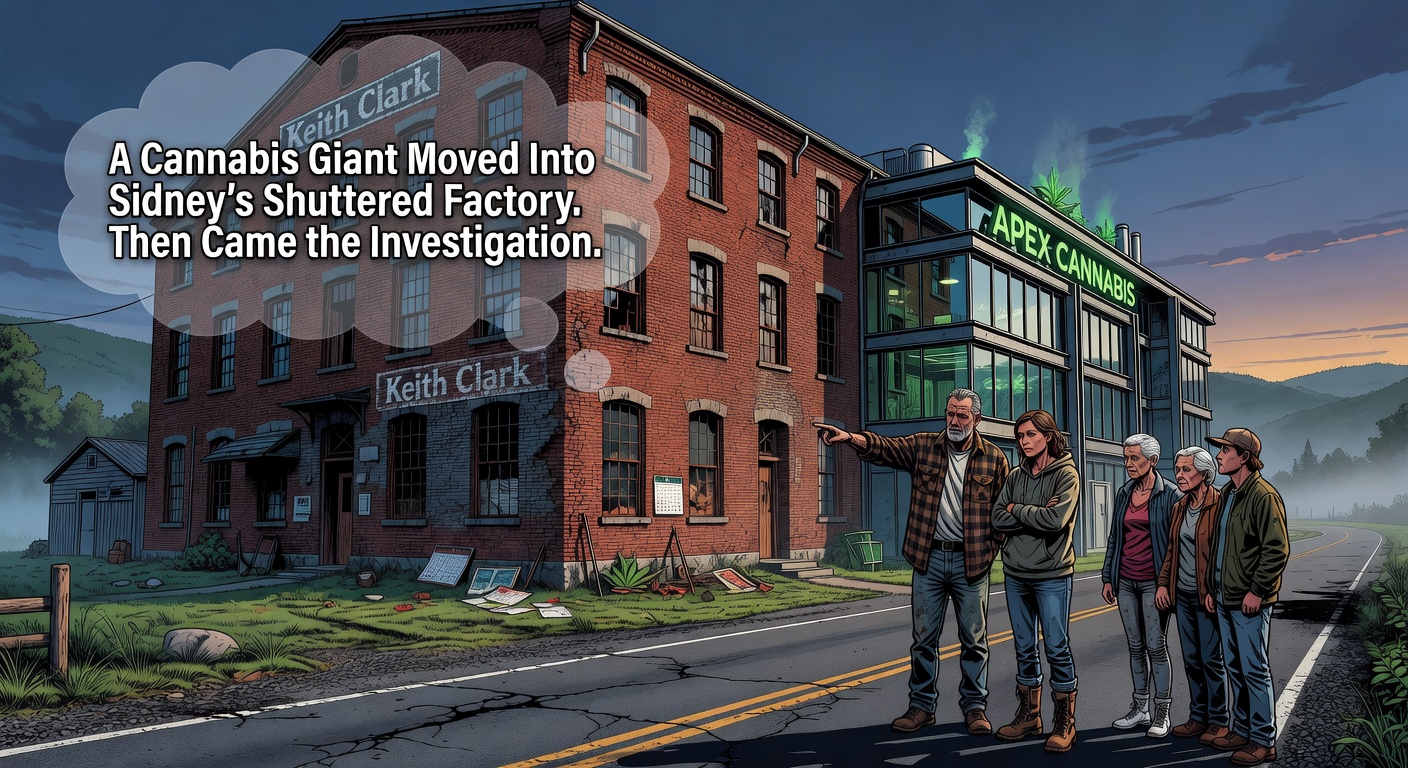
The old Keith Clark plant in Sidney, New York - a brick hulk set just off a two-lane county road in the Catskill foothills - spent more than half a century turning out appointment books and desk calendars. It was, for a small village of roughly 3,800 people, something close to an economic spine. When the factory finally went dark last year, Sidney lost not just jobs but a piece of its identity. What arrived next promised salvation. It delivered something considerably more complicated.
From Stationery to Cannabis: A Village's Reluctant Bet
Keith Clark, the company that gave the factory its name and Sidney's main park its name too, put down roots after World War II and became one of the largest makers of appointment books and diaries in the country. Workers there built careers - not gigs, careers - and the factory anchored the local tax base for decades. About ten years ago the business changed hands, still employing around 700 people. But digital calendars and online scheduling had been quietly gutting the stationery market for years. ACCO Brands, the new owner, finally pulled the plug.
Then came Stiiizy.
The Los Angeles-based company is the largest recreational cannabis brand in the United States, and earlier this year word reached Sidney that Stiiizy planned to move into the vacant plant. The numbers looked good on paper: up to 400 jobs, which would have made the company Sidney's second-largest employer. For Mayor Raymond Baker - a resident of more than four decades who took office in 2023 - the math was straightforward. Jobs bring homes. Homes bring businesses. Businesses generate the tax revenue a village like Sidney desperately needs.
Here's the catch. Many residents remain skeptical of cannabis legalization itself. Sidney isn't a progressive college town warming to a dispensary on Main Street; it's a small, conservative-leaning community in Delaware County being asked to stake its economic future on an industry a good portion of its residents view with suspicion. Baker called himself "cautiously optimistic." That qualifier was doing real work.
The Licensing Scandal That Unraveled Everything
Whatever ambivalence Sidney's residents felt about cannabis, they didn't get the chance to see the arrangement play out. A state investigation uncovered that Stiiizy was among several companies manufacturing and selling products under the licenses held by Omnium Health, a separate entity based on Long Island. In practice, that meant some of the industry's biggest brands were producing goods at Omnium's facilities without obtaining their own required licenses - a workaround that violated New York's regulatory framework.
In October, state officials began proceedings to ban Omnium from operating in New York entirely. The downstream effects hit Sidney fast. A factory that had gone from making appointment books to making cannabis products was, once again, facing an uncertain future.
New York's legal cannabis market has been beset by regulatory tangles since voters approved recreational use in 2021. The state's licensing process has been widely criticized as slow, opaque, and prone to exactly the kind of gray-market maneuvering the Omnium case illustrates. Big brands, eager to establish a footprint in one of the country's most lucrative potential markets, have sometimes found shortcuts more appealing than waiting for the bureaucratic machinery to turn. The result is an industry that generates headlines about billion-dollar potential while, on the ground, leaving communities like Sidney holding an empty bag.
What Sidney's Story Reveals About Rural Revival
Sidney's predicament isn't unique - it's a concentrated version of a problem visible across dozens of small towns in the Northeast and Rust Belt. A legacy employer disappears. The building sits vacant. A new industry - cannabis, warehousing, data centers - arrives with promises calibrated to local desperation. Sometimes the promises hold. Often they don't, or they come with conditions nobody anticipated.
The stationery-to-cannabis arc is almost too neat as metaphor: an analog industry literally replaced by a newly legalized one, each reflecting the economic currents of its era. But for the people in Sidney, it's not metaphor. It's the tax base. It's whether young families stay or leave. It's whether the park named after Keith Clark remains a memorial to better days or becomes part of something forward-looking.
Mayor Baker's cautious optimism has, for now, given way to cautious uncertainty. The factory still stands. The jobs haven't materialized. And the village - skeptical, hopeful, wary - waits again.