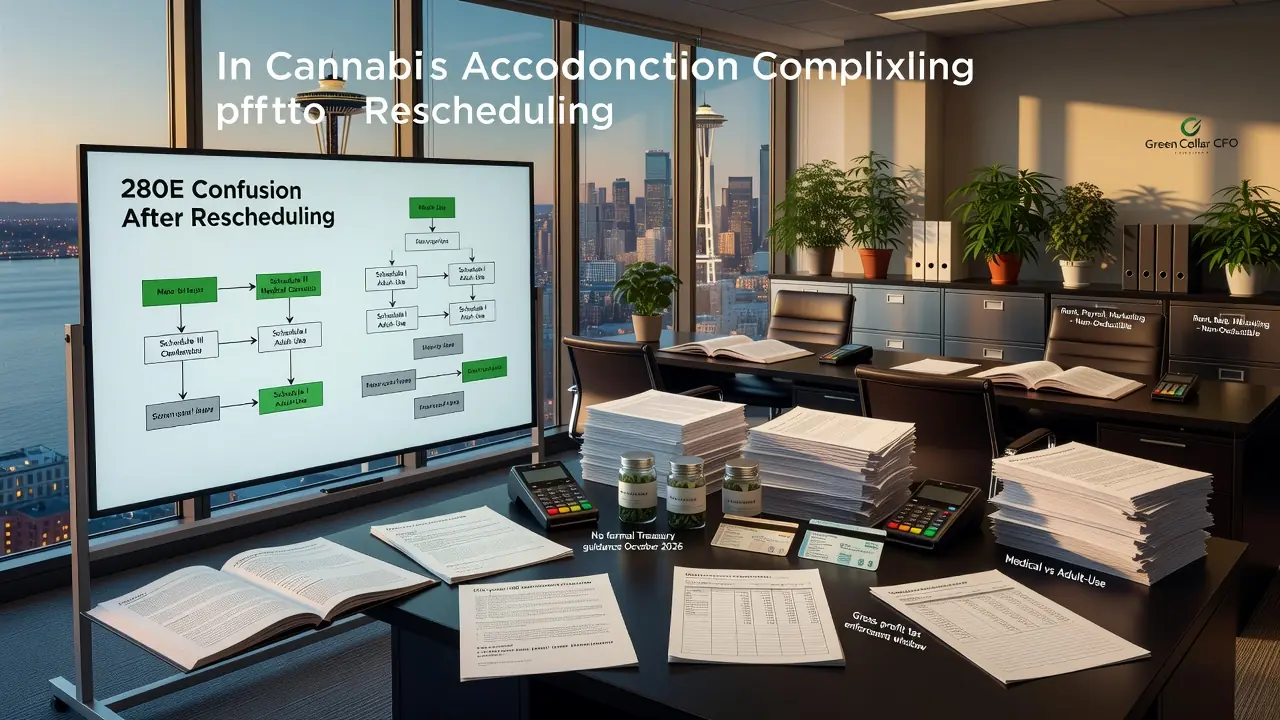
A Seattle-based accounting firm has published two guides aimed at clearing up one of the murkiest areas in cannabis finance right now: what federal tax law actually requires of operators after medical marijuana's move to Schedule III. Green Collar CFO, led by founder Amber Canady, released the guides in late October, timed to land just as operators start building year-end tax strategy. The timing is not incidental - confusion about 280E has only deepened since rescheduling took effect, not cleared up.
Why 280E Still Bites, Even After Rescheduling
Here's the catch that trips up a lot of owners: rescheduling marijuana to Schedule III did not simply erase 280E for the whole industry. According to the guide, it generally removes 280E as a barrier for medical activity conducted under a state medical license. Adult-use cannabis, the segment that drives most retail revenue in mature markets, stays under Schedule I and remains fully subject to 280E. That means a dispensary selling both medical and adult-use product likely needs to apportion expenses between the two lines of business - a bookkeeping exercise that is more complicated than it sounds, and one most point-of-sale systems were never built to handle cleanly.
Under 280E, a state-licensed cannabis business can only deduct cost of goods sold. Rent, payroll, marketing, insurance - the ordinary expenses any other retailer writes off - stay off the table for adult-use operations. The practical result is a federal tax bill calculated on gross profit rather than net income, which tends to produce an effective tax rate well above what a comparable non-cannabis retailer would ever see. Operators who budget as if 280E has quietly gone away are setting themselves up for an unpleasant surprise at filing time.
Treasury and the IRS have promised formal guidance on how 280E applies post-rescheduling. As of October 2026, according to the guide, that guidance had not arrived. No refund process for prior tax years has been announced either. For operators sitting on amended-return questions or wondering whether old 280E-driven tax bills might eventually be revisited, the honest answer right now is: nobody knows yet, and anyone claiming certainty is guessing.
Unfiled Returns: A Problem That Compounds Quietly
The firm's second guide tackles a less glamorous but more common problem - unfiled tax returns. In practice, though, this issue rarely stays contained to one missing 1040. A business owner who falls behind on a personal return is often behind on business and payroll filings too, since the same financial disorganization tends to touch everything at once. Payroll tax issues in particular carry sharper consequences, since the IRS treats withheld employee funds differently than ordinary business debt.
The guide notes that the IRS generally enforces delinquent filing going back about six years, based on internal policy rather than statute. That distinction matters: policy can shift, and it is not the same as a hard legal limit. Owners hoping a problem will simply age out of relevance are leaning on something softer than they might assume.
- Rescheduling changes 280E treatment for medical activity under state medical licenses, not adult-use cannabis
- Mixed medical and adult-use operators likely face expense apportionment requirements
- Federal 280E guidance remained unissued as of October 2026
- No refund mechanism exists yet for 280E taxes paid in prior years
- IRS delinquent-filing enforcement typically reaches back about six years, per agency policy
What This Means for Operators Heading Into Year-End
For dispensary owners and multi-state operators alike, the lesson isn't subtle: don't assume rescheduling fixed your tax exposure. To put it plainly, the compliance burden got more complicated, not simpler, for any business touching both medical and adult-use inventory. Accurate COGS tracking, clean separation of product lines in the books, and realistic cash reserves for a federal bill calculated on gross profit remain the baseline, not the exception. Operators with unfiled returns sitting in a drawer somewhere face a second layer of risk that compounds the longer it sits untouched - penalties accrue, and payroll issues in particular don't improve with age.