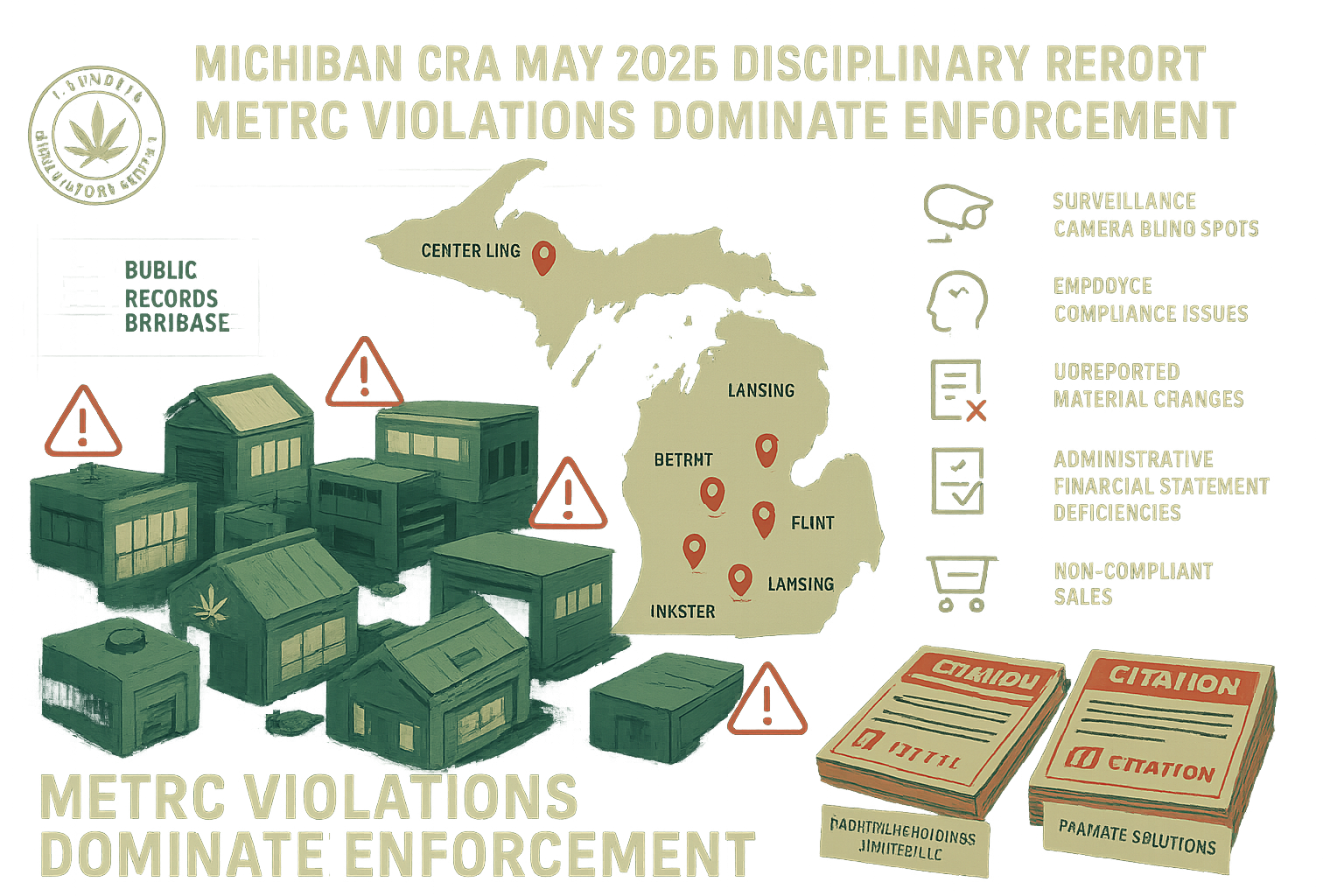
Inventory tracking failures are still the most stubborn compliance problem in Michigan's legal cannabis market. The Cannabis Regulatory Agency's May 2026 Disciplinary Action Report, released Tuesday and covering investigations completed during April, identified sixteen licensed businesses - growers, processors, retailers, safety compliance laboratories and medical marijuana licensees - that received formal disciplinary actions for a range of violations. The report makes clear that while the violations are varied, most stem from operational and administrative breakdowns rather than product safety failures or criminal conduct.
For operators building out compliance programs, the pattern here is worth examining carefully. Eight of the sixteen disciplinary actions involved METRC, Michigan's mandatory seed-to-sale tracking system - the same platform that records every cannabis plant and product from cultivation through retail sale and must reconcile against physical inventory at every step. Regulators in other tracked markets have found that when operators deploy purpose-built point-of-sale and back-office tools that integrate directly with state reporting systems, discrepancy rates tend to decline; dispensary software providers that offer their platform with native METRC integration are often positioned as a first line of defense against exactly the kind of record-keeping gaps Michigan is now citing. That said, technology is only part of the answer - the violations documented here span security, transfers, employee issues and financial reporting, suggesting that operational culture and internal auditing remain equally important.
METRC compliance is not a minor administrative formality. The system exists specifically to prevent marijuana from being diverted into the illicit market, and regulators treat discrepancies between METRC records and actual physical inventory as a serious integrity issue - not a paperwork error. A business flagged for METRC violations faces scrutiny that can extend well beyond the specific citation, since investigators may use tracking discrepancies as a starting point to examine transfer manifests, batch records and sales logs. For multi-location operators or vertically integrated businesses, a METRC problem at one facility can ripple into reviews of affiliated licenses.
What the Enforcement Geography Tells Operators
The April enforcement actions touched businesses in twelve Michigan municipalities - Benton Harbor, Center Line, Chesaning, De Tour Village, Detroit, Flint, Inkster, Jackson, Kalkaska, Lansing, River Rouge and Walled Lake. That spread matters. This wasn't a cluster of violations concentrated in one market or license type. Growers, processors, retailers and labs all appear in the report. The compliance pressure is distributed across the state's regulated supply chain, not isolated to a single segment.
Several businesses received multiple disciplinary actions stemming from the same investigation - a dynamic that signals compounding compliance failures rather than isolated incidents. Moneylineholdings Limited LLC in Chesaning drew four separate actions covering METRC compliance, surveillance requirements, employee issues and unauthorized transfers between marijuana businesses. Royal Highness LLC in River Rouge was cited across general operational deficiencies, METRC compliance, reporting violations and surveillance failures. Palmate Solutions LLC in Jackson faced multiple citations involving operational compliance and failure to report material changes to its licensed operations. When violations stack like this, the enforcement record becomes harder to manage and the path to license stability more complicated.
The Compliance Categories Operators Need to Audit Now
Beyond METRC, the May report's violation categories read like a checklist of the operational areas most likely to generate enforcement exposure in any regulated cannabis market:
- Surveillance and security deficiencies - a persistent issue across state markets, often tied to camera coverage gaps, retention failures, or equipment that hasn't been maintained to spec
- Improper transfers between licensed marijuana businesses - a compliance area that requires accurate manifests, verified license status of receiving parties and proper METRC tagging before product moves
- Failure to report material changes to licensed operations - a violation that catches operators who restructure ownership, change locations, or alter their operational scope without notifying regulators in advance
- Administrative Financial Statement (AFS) deficiencies - a less-discussed but significant exposure point, particularly for businesses that haven't kept financial records aligned with licensing requirements
- Non-compliant marijuana sales and production violations
- Employee compliance issues
The thing is, most of these violations are preventable with consistent internal auditing. A monthly self-inspection against the CRA's own compliance standards - covering METRC reconciliation, surveillance system checks, transfer documentation and employee badging records - would surface the majority of these issues before an inspector does. That's not a complicated program to build. It's a matter of whether operators are actually running it.
Transparency Mechanism and What It Means for the Industry
The CRA publishes these monthly disciplinary reports as part of its public transparency framework. That means the enforcement record is accessible - to local governments weighing license renewals, to wholesale partners evaluating whether to supply a retailer, to investors conducting due diligence, and to the public. A business that accumulates a documented compliance history doesn't just face regulatory consequences; it faces reputational exposure in a market where licensing relationships and wholesale access depend on perceived operational reliability.
Michigan's legal cannabis market is still maturing, and the CRA has been consistent in framing its enforcement program as compliance-oriented rather than punitive by design. The agency accepts public complaints, publishes a Citizens Guide explaining the complaint process, and maintains an online license verification database where disciplinary documents are available for review. That transparency infrastructure works in both directions - it exposes non-compliant operators, but it also gives well-run businesses a way to demonstrate their compliance record to partners and regulators alike. For operators who treat compliance as a core business function rather than a regulatory burden, the monthly report is a useful benchmark. For those who don't, it's eventually a matter of public record.